


Product List

- News Center:
- Home>
- News Center>
- Company News>
- News Details
In Stock | PNP-Phos Choline (CAS: 21064-69-7): Chromogenic Substrate for Phospholipase C Detection in Enzyme Activity Assays and Inhibitor Screening
2026/5/15 14:55:59 Browse volume(311)PNP-Phos Choline
In daily PLC activity detection, have you ever experienced such "crash moments": a new batch of substrate suddenly makes yesterday's standard curve invalid; the absorbance of blank wells inexplicably increases, drowning out carefully designed positive signals; reagents out of stock, delaying your project progress again and again... These problems are not isolated, and their root cause often points to the same type of raw material – the quality and supply stability of PLC substrate.
When we re‑examine this basic raw material, it becomes clear that the core value of an ideal PLC colorimetric substrate is not about boasting "innovation", but about providing batch‑to‑batch "certainty" that can be trusted. This is precisely the starting point for GeneSeqTools Bioscience & Technology's launch of 4-Nitrophenylphosphorylcholine (PNP-Phos Choline): from quality control at source, batch consistency to in‑stock supply, we strive to make "certainty" solid, helping to reduce the cost of method transfer and re‑validation caused by raw material switching.


Chinese Name: 4-Nitrophenylphosphorylcholine
English Name: 4-Nitrophenylphosphorylcholine
Abbreviation: PNP-Phos Choline
CAS Number: 21064-69-7
Molecular Formula: C11H17N2O6P
Molecular Weight: 304.24
Specifications: 100 mg / 500 mg / 1 g (Custom packaging supported)
Purity: ≥98% (HPLC)
Form: Off-white crystalline powder
Product Number: G03030005
Stock: In stock
Color: Yellow
PNP-Phos Choline is a PLC chromogenic substrate. Its principle is to produce a yellow reading at 405 nm after being cleaved by PLC. The substrate structure contains:
• A phosphorylcholine structure recognized by PLC;
• A p-nitrophenyl (pNP) chromophore for signal output;
When PLC catalyzes the hydrolysis of the substrate:
The released pNP forms a yellow anion under alkaline conditions and produces a characteristic absorption peak at 405 nm.
Compared with traditional natural phospholipid systems:
• No complex emulsification required;
• No lipid extraction required;
• More suitable for direct plate reading with a microplate reader;
• Easier to establish standardized PLC activity assay workflows;
1. Quantitative detection of PLC enzyme activity, used for:
• PLC activity determination;
• Enzyme kinetic studies;
• Km/Vmax analysis;
Helping researchers establish a more stable and intuitive PLC colorimetric detection system.
2. PLC inhibitor screening, suitable for:
• Small molecule inhibitor screening;
• Pathway inhibition studies;
• High-throughput drug screening platforms;
The 405 nm standard plate-reading system is more conducive to automated method development and data standardization.
3. Study of bacterial PLC virulence, used for:
• Clostridium perfringens;
• Bacillus cereus;
• Other bacterial PLC-related studies;
Helping establish bacterial virulence enzyme activity analysis models.
4. PLC signaling pathway studies, suitable for:
• PLC-IP3-DAG pathway studies;
• Upstream mechanism studies of Ca²⁺ signaling;
• Membrane signal transduction analysis;
As a classical methodological tool in PLC functional research.
In the raw material evaluation and method development stage, the product design and quality control of PNP-Phos Choline are strictly aligned with industrial application requirements, comprehensively reducing hidden costs from R&D testing to scaled production:
✅ Low Background and Batch Consistency – More Stable Detection Results
Product purity ≥98% (HPLC), helping to reduce blank background fluctuations caused by free pNP and degradation by-products, and minimizing detection bias and method drift caused by batch changes. For long-term PLC enzymology research and automated detection systems, this helps maintain standard curve consistency and data comparability, reducing the risk of revalidation.
✅ Phosphorylcholine Structure Guiding – PLC Detection Closer to Natural Substrate System
The product incorporates a phosphorylcholine head group, making it closer to the natural recognition substrate of PLC, allowing structural differentiation from conventional general phosphatase substrates. Compared to ordinary phosphate ester chromogenic systems, it is more conducive to reducing background interference caused by non-specific enzymatic hydrolysis.
✅ Mature Colorimetric System – Hassle‑free Experimental Implementation
The product is developed based on the classic pNP colorimetric detection route, making it more compatible with existing PLC detection workflows, reducing development pressure from method transfer, automation parameter adjustment, and historical data linkage. It is more suitable for long-term SOP system establishment and automated platform integration.
✅ Domestic In‑stock Supply – Peace of Mind for Long‑term Procurement
GeneSeqTools Bioscience & Technology offers in‑stock supply and flexible custom packaging services, regularly stocking research-grade (hundred‑milligram) to industrial-grade (gram) packs. Domestic in‑stock direct shipment effectively avoids project delays caused by import lead time fluctuations, helping enterprises optimize long‑term raw material procurement costs.
Different PLC detection scenarios have different requirements for substrate signal output, sensitivity, and methodological complexity. For application needs such as research detection, automated plate reading, high-sensitivity fluorescence analysis, and colony chromogenic screening, GeneSeqTools Bioscience & Technology provides multiple types of PC-PLC substrate solutions, covering colorimetric, chromogenic, and fluorescence detection systems.
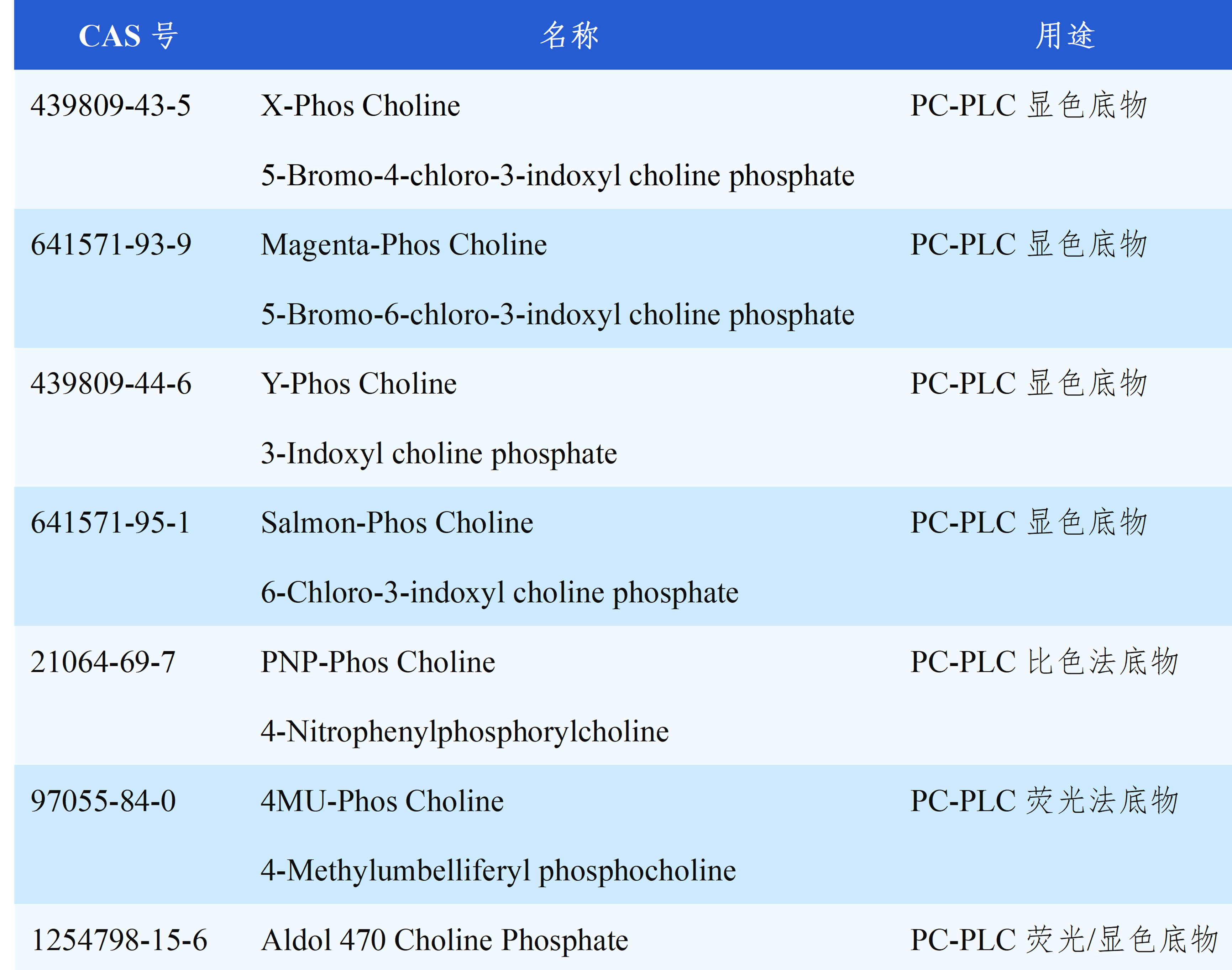

Extended Services
More than just color development – the foundation for long-term stability of PLC detection.
PNP-Phos Choline is in hot stock. Please call +86 13302967066!
GeneSeqTools Bioscience & Technology is dedicated to providing reliable domestic alternative solutions for gene sequencing, molecular diagnostics, and microbial detection.
For related products such as blood cell dyes and buffer salts, you can view the complete product line and technical specifications on [MedSun Biotechnology Website].

Founded in 2015, it is a high-tech enterprise focusing on microbial testing、 gene sequencing and in vitro molecular diagnostics in the R&D, production, and sales of biochemical reagent raw materials. Committed to providing high-quality biochemical reagent raw materials and professional custom synthesis services, the product portfolio covers more than a dozen categories and nearly a thousand innovative products. Upholding the core philosophy of “customer first, integrity and professionalism”, we serve with dedication to meet customers’ diverse needs in research and testing.

Official WeChat account: Shenzhen GeneSeqTools Bioscience & Technology Co. Ltd.
GeneSeqTools official website: http://www.geneseqtools.com
Hotline: +86 0755-23251735
QQ: 2370561481
Email: sales@geneseqtools.com
Related Links
- · FAQs about Geneseqtools BioTech [2024-07-04]
- · In Stock | Yeast Two-Hybrid Screening Made Easy — X-α-Gal Turns Positive Clones Blue [2026-09-09]
- · In Stock | Magenta-Gal: A Magenta β-D-Galactosidase Chromogenic Substrate for Instant Identification of Positive Clones [2026-09-11]
- · Hot Product | Principles and Applications of S-2366 (Pyr-Pro-Arg-pNA) for Coagulation Factor FXIa Activity Detection [2026-09-15]
- · In Stock | Rapid Visual Detection of Cronobacter in Infant Formula Milk Powder: Domestic X-α-Glc Solution [2026-09-18]
- · Double Holiday Approaching: Have You Arranged Your Orders? GeneSeqTools Holiday & Shipping Notice [2026-09-22]
- · Raw Materials as the Foundation, Innovation as the Drive | GeneSeqTools at the 20th Academic Symposium on Microbial Culture Media [2026-09-29]
- · In Stock | Key Raw Material for Salmonella Chromogenic Media: Application Analysis of Magenta-Caprylate [2026-09-30]
