


Product List

- News Center:
- Home>
- News Center>
- Company News>
- News Details
New Release | H-D-Ala-AMC ∙ TFA: AMC Fluorescent Substrate for Rapid Evaluation of Food Microbial Activity
2026/7/3 14:02:26 Browse volume(207)H-D-Ala-AMC · TFA
From detecting microorganisms to evaluating microbial activity – food safety research is evolving.
In the field of food safety research, researchers are not only concerned about whether microorganisms are present in samples, but also whether these microorganisms are active and whether they possess specific metabolic capabilities.
For example, during food production, cold-chain transportation, and quality control, the same microbial count does not necessarily indicate the same level of risk. The metabolic state, enzyme activity, and growth ability of microorganisms often provide more valuable information.
Therefore, more and more research is attempting to evaluate microbial activity through enzymatic signals, aiming to obtain faster feedback compared to traditional culture methods.
D-Alanine 7-amido-4-methylcoumarin trifluoroacetate salt (abbreviated: H-D-Ala-AMC · TFA) is one of the AMC-series fluorescent substrates that has gained attention in this context.

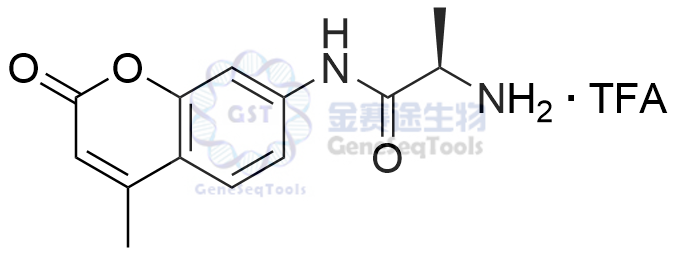
Chinese Name: D-Alanine 7-amido-4-methylcoumarin trifluoroacetate salt
English Name: D-Alanine 7-amido-4-methylcoumarin trifluoroacetate salt
Abbreviation: H-D-Ala-AMC · TFA
CAS Number: 201847-52-1
Molecular Formula: C15H14F3N2O4
Molecular Weight: 343.28
Specifications: 1 g / 5 g / 25 g (Custom packaging supported)
Form: Off-white crystalline powder
Product Number: G04050021
Stock: Made to order
Signal: Blue fluorescence
H-D-Ala-AMC · TFA is a fluorescent protease/peptidase substrate based on AMC (7-amino-4-methylcoumarin), consisting of D-alanine (D-Ala) coupled with the AMC fluorophore via an amide bond. Its core detection logic can be summarized in three stages: "cleavage – release – fluorescence":
1. Enzyme-specific recognition and cleavage
H-D-Ala-AMC · TFA adopts the D-amino acid configuration, providing stereoselectivity for D-alanine aminopeptidase. As D-alanine is a characteristic component of bacterial cell wall peptidoglycan, this substrate offers clear specificity for bacterial enzyme activity detection. When the target enzyme is present in the sample, it specifically recognizes and hydrolyzes the D-alanine-AMC amide bond in the substrate.
2. Release of the AMC fluorophore
In the intact substrate, the AMC group is coupled with D-alanine and is in a weakly fluorescent or nearly non-fluorescent state. After enzymatic cleavage, AMC is released as free 7-amino-4-methylcoumarin molecules.
3. Production and quantification of blue fluorescence signal
Free AMC exhibits strong blue fluorescence, with an excitation peak around 341 nm and an emission peak around 441 nm. Fluorescence intensity is proportional to enzyme activity and can be monitored in real time and quantified using a standard fluorescence microplate reader.
1. Fluorescent screening of foodborne pathogens
Used to detect specific bacteria such as Enterobacteriaceae and Clostridium perfringens.
2. Rapid microbiological quality testing of chilled meat
Used to detect microbial enzyme activity collected from the surface of aerobically chilled pork and beef, allowing rapid assessment of the microbiological quality of chilled meat via fluorescence signal intensity.
3. Enzyme activity detection and enzyme kinetics studies
Used for activity determination of aminopeptidases and related peptidases, analysis of enzyme kinetic parameters (Km, Vmax), and inhibitor screening.
✅ High purity control, ensuring detection consistency
• High-purity system: Purity ≥98%, ensuring batch-to-batch stability.
• Controllable background: Reduces non-specific fluorescence interference and minimizes background impact on signal interpretation.
• Trifluoroacetate salt form: More stable than the free base, facilitating storage and use.
✅ Fluorescence detection, sensitive and efficient
• Strong fluorescence signal: Releases AMC blue fluorescence after cleavage.
• Supports quantitative analysis: Fluorescence intensity correlates with enzyme activity, enabling quantitative evaluation of enzyme activity levels.
• High detection efficiency: Based on enzyme activity fluorescence signal detection, results can be obtained in a shorter time, providing a rapid reference for food microbial screening research.
✅ Good specificity, bacteria-targeted
• D-configuration selectivity: Designed based on D-alanine structure, suitable for fluorescence detection and research of bacterial D-alanine aminopeptidase activity.
• Reduced cross-reactivity: Provides more targeted detection signals for related enzyme activity analysis in complex sample systems such as food.
✅ Platform compatible, easy to operate
• Compatible with mainstream AMC fluorescence detection platforms: Ex/Em ≈ 341/441 nm, compatible with DAPI filter sets and standard fluorescence microplate readers.
• Simple operation: "Add sample – incubate – read fluorescence" three-step procedure, no complex pre-treatment required.
• Automation-ready: Suitable for 96/384-well high-throughput screening systems.
✅ Reliable supply, cost optimization
• Cost advantage: Leveraging the domestic supply chain, the cost for the same quality is significantly lower than imported brands.
• Domestic supply: Controllable lead times and stable delivery, reducing procurement cycle risks.
• Multiple specifications available: Available in 1 g / 5 g / 25 g, with custom packaging supported.

Extended Services
D-Alanine configuration design makes bacterial enzyme activity detection more targeted.
For more "peptidase chromogenic substrates" or custom services, please call +86 13302967066!
GeneSeqTools Bioscience & Technology is dedicated to providing reliable domestic alternative solutions for gene sequencing, molecular diagnostics, and microbial detection.
For related products such as blood cell dyes and buffer salts, you can view the complete product line and technical specifications on [MedSun Biotechnology Website].

Founded in 2015, it is a high-tech enterprise focusing on microbial testing、 gene sequencing and in vitro molecular diagnostics in the R&D, production, and sales of biochemical reagent raw materials. Committed to providing high-quality biochemical reagent raw materials and professional custom synthesis services, the product portfolio covers more than a dozen categories and nearly a thousand innovative products. Upholding the core philosophy of “customer first, integrity and professionalism”, we serve with dedication to meet customers’ diverse needs in research and testing.

Official WeChat account: Shenzhen GeneSeqTools Bioscience & Technology Co. Ltd.
GeneSeqTools official website: http://www.geneseqtools.com
Hotline: +86 0755-23251735
QQ: 2370561481
Email: sales@geneseqtools.com
Related Links
- · FAQs about Geneseqtools BioTech [2024-07-04]
- · In Stock | Yeast Two-Hybrid Screening Made Easy — X-α-Gal Turns Positive Clones Blue [2026-09-09]
- · In Stock | Magenta-Gal: A Magenta β-D-Galactosidase Chromogenic Substrate for Instant Identification of Positive Clones [2026-09-11]
- · Hot Product | Principles and Applications of S-2366 (Pyr-Pro-Arg-pNA) for Coagulation Factor FXIa Activity Detection [2026-09-15]
- · In Stock | Rapid Visual Detection of Cronobacter in Infant Formula Milk Powder: Domestic X-α-Glc Solution [2026-09-18]
- · Double Holiday Approaching: Have You Arranged Your Orders? GeneSeqTools Holiday & Shipping Notice [2026-09-22]
- · Raw Materials as the Foundation, Innovation as the Drive | GeneSeqTools at the 20th Academic Symposium on Microbial Culture Media [2026-09-29]
- · In Stock | Key Raw Material for Salmonella Chromogenic Media: Application Analysis of Magenta-Caprylate [2026-09-30]
