


Product List

- News Center:
- Home>
- News Center>
- Company News>
- News Details
New In-Stock Product | Detecting Glycine Aminopeptidase: Choosing the Right Substrate is Key — The Classic H-Gly-pNA Chromogenic Solution
2026/8/13 15:09:23 Browse volume(132)H-Gly-pNA
Glycine aminopeptidase (GAP) is a class of enzymes that specifically hydrolyze N-terminal glycine residues on peptide chains, widely distributed in soil microorganisms, gut microbiota, and some clinically relevant microorganisms. Its activity levels can provide reference data for strain metabolic characteristics, nutrient utilization capabilities, and functional studies.
For the detection of glycine-preferring enzymes, the substrate not only determines the signal strength but also directly affects the accuracy and development efficiency of the detection system. Therefore, detection substrates with clear recognition capabilities and mature methodologies are often key to establishing stable enzyme activity analysis methods.
Glycine p-nitroanilide (H-Gly-pNA), as a classic pNA chromogenic substrate, releases the pNA chromophore upon enzymatic cleavage, enabling colorimetric detection of glycine aminopeptidase and related protease activities, providing a reliable chromogenic analysis tool for microbial detection and enzymology research.
I. Product Overview

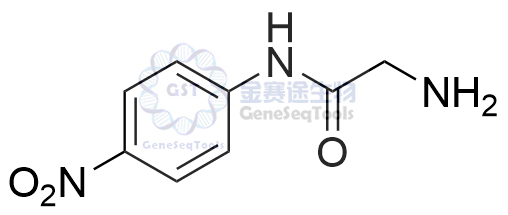
Chinese Name: Glycine p-nitroanilide
English Name: Glycine p-nitroanilide
Abbreviation: H-Gly-pNA
CAS Number: 1205-88-5
Molecular Formula: C8H9N3O3
Molecular Weight: 195.18
Specifications: 1 g / 5 g / 25 g (Custom packaging supported)
Form: Off-white crystalline powder
Product Number: G04040018
Stock: In stock
Signal: Yellow (pNA)
The H-Gly-pNA series products suitable for glycine aminopeptidase detection system development are as follows:
1. CAS: 1205-88-5, H-Gly-pNA
2. CAS: 54643-65-1, H-Gly-pNA ∙ HCl
II. Working Principle
Glycine p-nitroanilide belongs to the pNA chromogenic substrate system, primarily used for detecting glycine aminopeptidase and related protease activities. After the target enzyme recognizes the substrate, an enzymatic hydrolysis reaction occurs, releasing the p-nitroaniline (pNA) chromophore, enabling enzyme activity analysis through absorbance changes.
1. Target recognition and reaction triggering
The target enzyme recognizes the glycine structural unit in glycine p-nitroanilide and triggers an enzymatic cleavage reaction.
Recognition targets include:
• Glycine Aminopeptidase (GAP)
• Glycine-preferring proteases
• Prolyl endopeptidase (PEP)
• Some aminopeptidase class proteolytic enzymes
2. Signal generation
After enzymatic hydrolysis, the p-nitroaniline chromophore is released, and the system directly produces a visible yellow signal during the reaction. No fluorescence excitation or additional coupled enzyme steps are required to achieve stable and intuitive colorimetric response.
3. Signal quantification
Changes in absorbance at 405 nm are measured using a spectrophotometer or microplate reader for quantitative analysis of pNA release. Signal intensity is positively correlated with enzyme activity levels and can be used for enzyme activity determination and related methodological evaluation and system optimization.
III. Application Scenarios
1. Microbial glycine aminopeptidase activity detection
Used in the development of microbial detection systems, assisting in the evaluation of strain-related enzyme activity characteristics by detecting glycine aminopeptidase activity produced by strains.
Typical applications include:
• Microbial enzymology identification based on glycine aminopeptidase activity
• Targeted screening of glycine aminopeptidase-producing strains
• Evaluation of glycine metabolic capacity
Helping microbial testing companies, culture media R&D companies, and research institutions establish screening and identification methods based on enzyme activity differences.
2. Substrate development for microbial culture media/identification systems
Used in the R&D of functional microbial culture media and identification systems, enabling strain-specific enzyme activity detection.
Suitable for the following development directions:
• Development of differential/chromogenic culture media based on glycine aminopeptidase activity
• Performance evaluation and optimization of culture media for glycine aminopeptidase-producing strains
• Design of novel detection systems based on glycine aminopeptidase chromogenic reactions
Helping culture media companies and microbial testing companies develop differentiated enzymology identification products based on glycine aminopeptidase activity.
3. Protease/aminopeptidase activity analysis
Used in the establishment of protease and aminopeptidase activity detection systems, enabling quantitative evaluation of enzyme activity levels.
Common research directions include:
• Glycine aminopeptidase detection
• Proteolytic enzyme activity evaluation of glycine aminopeptidase-producing strains
• Enzyme kinetic studies based on glycine aminopeptidase activity analysis
Helping enzyme preparation companies, research institutes, and biological reagent R&D companies establish standardized enzyme activity analysis methods targeting glycine aminopeptidase.
IV. Core Advantages
✅ Mature and stable pNA chromogenic system, intuitive detection signals
• Mature methodological application: pNA chromogenic substrates have been widely used in enzyme activity detection, with clear detection principles and well-established experimental methods.
• Easy-to-interpret color results: Enzymatic release of the pNA chromophore enables direct colorimetric detection with intuitive signal changes.
• Reduced method development difficulty: Helps rapidly establish standardized enzyme activity analysis systems, reducing substrate screening and method optimization workloads.
✅ Targeted recognition of glycine aminopeptidase
• Designed for glycine cleavage activity: Suitable for glycine aminopeptidase and related protease activity detection.
• Enhanced target enzyme detection specificity: Based on glycine residue-related substrate reactions, providing substrate options for establishing specific aminopeptidase activity detection systems.
• Supports enzymology research and product development: Suitable for enzyme activity analysis, strain evaluation, and related detection reagent R&D.
✅ Outstanding application value in microbial enzymology detection
• Adapted to microbial enzyme activity analysis needs: Can be used for strain enzyme activity evaluation and metabolic capacity studies.
• Supports culture media and identification system development: Provides substrate raw material options for functional culture media and enzymology identification products.
• Expands microbial detection application scenarios: Meets the development needs of microbial testing companies for enzymatic substrates.
✅ In-stock supply, domestically developed for stable procurement
• Domestically developed: Key synthetic routes and purification processes are independently developed, with an independently controllable supply chain, reducing import dependence and providing customers with more flexible and stable domestic alternative options.
• Excellent batch-to-batch consistency: Equipped with quality control systems including HPLC and methodological validation, ensuring quality control from raw materials to finished products, reducing batch-to-batch variability and providing stable substrate support for enzyme activity detection and microbial identification system development.
• In-stock supply: Regularly stocked inventory supporting multiple specifications from gram to kilogram scale, meeting material needs for R&D validation, method development, and production stages.

Extended Services
Targeting glycine aminopeptidase, colorimetric quantification with ease.
For more "peptidase chromogenic substrates" or custom packaging services, please call +86-13302967066!
GeneSeqTools Bioscience & Technology is dedicated to providing reliable domestic alternative solutions for gene sequencing, molecular diagnostics, and microbial detection.
For related products such as blood cell dyes and buffer salts, you can view the complete product line and technical specifications on [MedSun Biotechnology Website].

Founded in 2015, it is a high-tech enterprise focusing on microbial testing、 gene sequencing and in vitro molecular diagnostics in the R&D, production, and sales of biochemical reagent raw materials. Committed to providing high-quality biochemical reagent raw materials and professional custom synthesis services, the product portfolio covers more than a dozen categories and nearly a thousand innovative products. Upholding the core philosophy of “customer first, integrity and professionalism”, we serve with dedication to meet customers’ diverse needs in research and testing.

Official WeChat account: Shenzhen GeneSeqTools Bioscience & Technology Co. Ltd.
GeneSeqTools official website: http://www.geneseqtools.com
Hotline: +86 0755-23251735
QQ: 2370561481
Email: sales@geneseqtools.com
Related Links
- · FAQs about Geneseqtools BioTech [2024-07-04]
- · In Stock | Yeast Two-Hybrid Screening Made Easy — X-α-Gal Turns Positive Clones Blue [2026-09-09]
- · In Stock | Magenta-Gal: A Magenta β-D-Galactosidase Chromogenic Substrate for Instant Identification of Positive Clones [2026-09-11]
- · Hot Product | Principles and Applications of S-2366 (Pyr-Pro-Arg-pNA) for Coagulation Factor FXIa Activity Detection [2026-09-15]
- · In Stock | Rapid Visual Detection of Cronobacter in Infant Formula Milk Powder: Domestic X-α-Glc Solution [2026-09-18]
- · Double Holiday Approaching: Have You Arranged Your Orders? GeneSeqTools Holiday & Shipping Notice [2026-09-22]
- · Raw Materials as the Foundation, Innovation as the Drive | GeneSeqTools at the 20th Academic Symposium on Microbial Culture Media [2026-09-29]
- · In Stock | Key Raw Material for Salmonella Chromogenic Media: Application Analysis of Magenta-Caprylate [2026-09-30]
